Je ne vous en voudrais pas si vous ne connaissez pas Arkhangelsk dans le nord de la Russie, à 600 km à l’est de la Finlande, une région pleine de lacs boueux parait-il, un endroit où même les Range-Rover, Jeep ou Land-Rover ne passent pas d’après les autochtones… (NDR : Franchement je demande à voir… J’y crois pas beaucoup).
Un gars du coin, le neveu de la guérisseuse locale (Nina Vorontsova) dit avoir construit en 2016 une alternative au Mercedes G63 AMG 6×6 pour pouvoir se déplacer tranquillement là où il veut.
Le problème c’est qu’il est parti d’une SMZ S-3D, une voiturette sans permis, animée par un tout petit moteur d’un cylindre de 346 cm3… de 18 cv ! Alors bon, si son truc passe mieux qu’un Range-Rover ? Laissez-moi des commentaires pour me dire ce que vous en pensez ! 😡
Il a 6 roues de Lada Niva montées de pneus de tracteur d’une autre époque. Chez moi dans l’Aisne, en France, un tracteur ça ressemble pas du tout à ça, c’est carrément plus gros. Parait que le volant vient d’une Opel… Vous voulez savoir ? On s’en fout !
Ça me mets hors de moi qu’on puisse comparer cette merde à un Mercedes G63 AMG 6×6. La seule ressemblance possible c’est des 6 roues, et encore ! 👿
Donc on ne sait rien sur cet engin, même pas si il roule ! Si vous en savez plus laissez-moi des commentaires !
Autant j’adore les marques Russes, mais pas cette chose.
Je vous mets la vidéo du modèle de base, la SMZ S-3D
D’après mon ami L.C. :
Il s’agit d’un véhicule sheltérisé (emploi d’un shelter). C’est un véhicule de commandement ou de guidage avion.
Le shelter sert à isoler des impulsions électromagnétiques et les résidus NRBC.
A première vue, ce serait pour du guidage sol-air : avions, missiles, etc…
Mais le dome peut accueillir d’autres options, Il peut être placé sur la côte pour la détection navale des bateaux, mais aussi en détection météo.
Pourquoi un Mercedes ?
– Soit c’est un ancien Peugeot P4.
– Soit c’est un prêt de l’armée allemande.
– Soit c’est un Mercedes G des Forces Spéciales.
Il est possible que ce véhicule soit utilisé par le CFST (Commandement des Forces Spéciales Terrestres) basé à l’aéroport de PAU, mais ce ne sont que des suppositions.
Merci à Lionel (Harry) pour ses photos prises non loin du Mans sur l’autoroute en septembre 2017.
Voici un Toyota Land Cruiser V8 6×6 exceptionnel, conçu et construit à Pretoria, en Afrique du Sud par TJM Pta-East. Avec tous ses accessoires, six roues de 37 pouces, ce Cruiser est un 6×6 dans le vrai sens du terme.
Les trois essieux peuvent être entraînés par le moteur V8, c’est comme on veut et il existe également un verrouillage différentiel pour chaque essieu. Créé dans un esprit militaire, ce 6×6 peut transporter 3,5 tonnes de charge utile dans sa benne. La base est faite du nouveau Land Cruiser double cabine V8 4.5D-4D. Le châssis a été prolongé d’environ un mètre, et le châssis entier d’origine a été renforcé avec de l’acier Domex. Le troisième essieu est également un produit Toyota OEM standard avec un différentiel verrouillable. Les deux différentiels arrière sont supportés par des ressorts à lames TJM. Le troisième essieu est entrainé par un arbre créé par TJM. Il est possible de greffer beaucoup d’accessoires existant sur la benne, comme des cellules de vie. Pour les applications industrielles, minières, de lutte contre les incendies et les services d’urgence, il est aussi possible d’y installer une benne avec des ouvrants latéraux. Les passages de roues sont faits pour accueillir des pneus jusqu’à 40 pouces.
TJM vante son Toy 6×6 comme étant le plus spectaculaire, différent et sauvage du monde, à vous de voir !
Caractéristiques :
V8 Double Cabine Conversion 6 roues motrices, extension de châssis et une benne simple Jantes militaires 8×17 » Genuine Bead-lock Military Spec Jims (comme sur le Humvee) Pneus 37″ Cooper STT Pro Réservoir de carburant de 236 litres Treuil Powerplant de 5,5 tonnes Suspension TJM Bas de caisse Onca-Heavy Duty Pare-choc avant sur mesure Onca-Heavy Duty Pare-chocs arrière sur mesure Onca-Heavy Duty avec porte-roue de secours Benne caoutchoutée
6 roues de 50 pouces avec des pneus spéciaux aérés pour laisser passer la poussière
Electrique alimenté par des panneaux solaires
Vitesse normale : de 10 à 25 km/h
Vitesse maximum : 110 km/h si le relief le permet
Constructeur : NASA Kennedy Space Center Visitor Complex
Location : Cap Canaveral (Floride)
Destination : Planète Mars
Concepteur : Marc Parker
Ils ont mis 5 mois à le fabriquer, de novembre 2016 à avril 2017.
Ce véhicule tout terrain a été imaginé par la NASA pour faire une exploration habitée de la planète Mars. Il est équipé d’un laboratoire d’analyse autonome et amovible à l’arrière de l’engin. Une fois le laboratoire séparé, le rover devient un 4×4. L’histoire ne dit pas comment le laboratoire tient tout seul sur 2 roues !
C’est une étude de style, il ne roulera jamais sur la planète rouge. Il a été conçu pour sensibiliser le publique aux grands défis de l’exploration spatiale et des voyages interplanétaires, pour une agence nommée « Summer of Mars ».
Dans l’avenir il véhicule servira de support publicitaire à son sponsor, une célèbre chaine de télé américaine, après avoir été exposé dans divers lieux par la NASA.
CSK Automotive est un garage anglais spécialisé dans les BMW et les Mini.
Tous les ans, histoire de faire un peu de pub, ils créent un projet particulier.
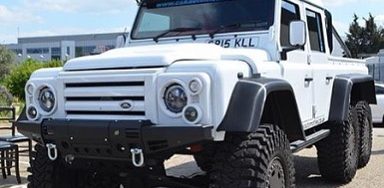
En 2016, ils sont partis d’un Defender 110 DC 4×4 pour en faire un 6×6 aux normes usine, sans aucun bricolage, du travail de pointe.
Il est équipé d’un kit de suspension qui le rehausse de 6 pouces (15,24 cm) avec des amortisseurs à gaz, de pneus de 37 pouces sur des jantes en acier, d’une protection de châssis anti-rouille. Il a aussi un treuil discret à l’avant, des vitres teintées, un plancher effet bois dans la benne, phares leds, et pleins de choses pour l’enjoliver !
A l’intérieur c’est aussi un inventaire de jolies choses modifiées, sièges Recaro, insonorisation extérieure, cuir rouge partout, y compris sur les poignées de portes, éclairage led intérieur, équipement hi-tech wi-fi et hi-fi, avec écrans, Hp 8 pouces, caisson de basse, le top du top tuning.
Chose étonnante, il a été conçu en 6×6, mais le projet d’après était un 4×4 fait sur un 4×2 , un essieu moteur a été gardé à la vente. Il est donc devenu un 6×4… Dommage !
Il a participé au Rallye Modball et a obtenu une bonne note.
Conversion Suzuki Jimny JA11 en Mercedes-Benz G63 AMG 6 × 6 pour 7.800,00 €
Cette superbe conversion est due à l’école japonaise Nihon Automotive Technology School (NATS ), un équivalent de Espera Sbarro en Europe.
Quatre formations sont disponibles pour les 750 étudiants. La première est le cours de maintenance, qui est un programme de deux ans qui prépare les étudiants à l’examen national requis pour devenir mécanicien de classe 2. Ensuite, les étudiants peuvent poursuivre leurs études avec trois cours avancés: Personnalisation, Motorsports et Recherche.
C’est pour le cours de Personnalisation que 12 étudiants ont travaillés sur ce projet (au lieu de 7 à 8 habituellement).
L’idée était de créer un gros SUV, mais après discussion avec les profs, ils ont décidés de créer un 6×6 miniature adapté au trafic japonais avec un budget de 1 million de yens, soit 7.800,00 €, sous l’autorité de leur professeur, Monsieur Yoshihisa Takayama.
Le projet a été initié en avril, l’étude a été menée jusque en juin où la construction a débuté, pour finir au salon de Tokyo en janvier 2017. Près d’une année a été nécessaire pour cette transformation. Un test public réel s’en est suivi sur les routes japonaises afin d’obtenir une véritable certification.
Deux Suzuki Jimny JA11 ont étés réquisitionnés pour la création du mini Mercedes-Benz G63 AMG 6×6. Ils ont été découpés, ressoudés, arrangés, le moteur d’origine a été conservé.
Un essieu libre a été rajouté à l’arrière, et c’est donc bien d’une 6×4 dont il s’agit !
Un bon nombre d’équipement extérieurs ont étés fidèlement reproduit à la nouvelle échelle, la calandre, tous les feux, les rétroviseurs et les parechocs. Le fond de la benne a été staffé bois alors que sur le vrai c’est un véritable plancher.
Le vrai Mercedes-Benz G63 AMG 6×6 coûte environ 450.000 €, le Suzuki de l’école NATS à prix réduit, est une très belle réussite, il va faire parler de lui sur toute la planète !
Les 2 Suzuki Jimny JA11 qui ont étés utilisés
Le châssis et la carrosserie sont indépendants
La nouvelle calandre fidèle à l’originaleLe faux bois, staffé !Monsieur Yoshihisa Takayama, le Professeur de NATSLe dernier essieu est libre, c’est un 6×4Tests de roulage sur le circuit privé de l’école NATS
Au départ elle était américaine, elle a été gagnée dans le show télé « Eureka » (parait-il très populaire) par des gens qui
l’ont revendue rapidement pour ne pas payer plus d’impôt…
La valeur déclarée de la Toyota était de 75.000 $ et elle a été vendue 25.000 $ aux enchères.
Le nouveau propriétaire New-Yorkais en a fait un véhicule publicitaire dédiée à un déodorant pour homme du nom de « Degree » et il l’a mis un jour en vente sur eBay, c’est comme ça que je l’ai connu.
A sa vente sur eBay en 2009, le Toyota était équipée de 2 écrans de télé de 42 pouces,
un dans le coffre et un autre qui se déployait sur le toit, surmonté d’un éclairage au néon en forme de fusée.
Il y avait aussi une console de jeu, un lecteur DVD et une hi-fi connectée.
La porte papillon arrière droite donnait accès à un ordinateur capable de mesurer votre niveau d’adrénaline lorsque vous scanniez la paume de votre main.
C’est en 2010 que le nouveau propriétaire c’est fait connaitre sur un site Russe, Monsieur Vitali de la ville de Maïkop. Mais depuis, plus de nouvelle, peut-être un jour prochain ?
C’est une très belle machine, mais comme toujours, faites attention aux mauvaises copies sur Internet, je vous mets un fake en bonus !
Encore une histoire incroyable sur SixMania ! La société Turtle Transit, spécialisée dans les voitures publicitaires à été sollicité pour faire la nouvelle campagne de publicité pour Nike et sa nouvelle ligne Nke6 en 2006 (d’où les 6 roues !). Elle a été construite en 4 semaines… Elle est sensée représenter la chaussure ci-dessus ! Merci à Jean Pierre Lafond pour l’initiation du sujet.
Une des réalisation connues de Turtle Transit
C’est marqué dessus, NKE6.COM !!!
Bon, faut aimer ! Encore que, sur la caravane du tour de France, ça le ferait bien !
3 fonds d’écrans Nike avec une représentation de la Seagle !
Il s’appelle Sheikh Hamad bin Hamdan Al Nahya et il déteste les voitures toutes faites, ce n’est pas qu’il n’aime pas les Ferrari ou les Mercedes, mais il les préfère customisées, tunées…
Il est très riche et aime les automobiles uniques si bien qu’il se les fait construire sur mesure.Il vit au Maroc, où ce membre de la famille royale d’Abu Dhabi a fait de Rabat sa résidence principale, le milliardaire émirati ne passe pas inaperçu à bord de ses véhicules loufoques.
Il possède environ 600 véhicules, son parc situé près d’Abou Dhabi a même été transformé en un gigantesque musée automobile, ouvert au public.
Ce gros camion hors normes est un appartement roulant, vous trouverez des vidéos de son intérieur sur Youtube !
Et donc, allez savoir pourquoi et comment, il s’est offert une transformation de Nissan Patrol en 8×8 pour le plaisir de SixMania !!
La question serait de savoir si ça roule ? Mais oui !!
En voici la démonstration
Il aime les Nissans Patrol, même en 6×6…
Version originale 6×6 ou 4×4 avec roues de secours…
A British 4×4 tour company takes intrepid off-roaders to the wilds of Arctic Russia on what they bill as the ‘Ends of the Earth’ Expedition. When the tide of the White sea is out you drive 30km down the beach to a forlorn, bleached-wood settlement where a few 4x4s are parked. Across the choppy deep-blue estuary are some more houses but I hesitate to call it a village. There are no cars on the other side because you are standing at the furthest place it’s possible to drive to on the north east of the European continent. I know this well because I run World 4×4 Adventures and know just how wild and remote the stunning Kola peninsula is… but then at one of the extreme off-roading competitions Russia is famous for I met Alexey Makarov and he began telling me about his trip about 1000km east of what I thought was the ‘last drivable point in Europe’.
“But how?” I asked little incredulously. “There are no roads!”
Unknowingly emulating the immortal words of Dr Emmet Brown at the end of Back to the Future he replied, “Roads? We don’t need roads!” A DeLorean with Flux-capacitor (I’ve always wanted to write that in one of my articles!) he didn’t have, but two huge 6x6s with tyres so huge that the vehicles actually float, he did! They are called Makars and when you stand next to them they are stunning vehicles. They look like they are ready to be sent to survey the surface of distant worlds and as Alexey clicked through his photos on his well-travelled laptop it looked like that’s exactly what he’d just done. The shots he was casually clicking through were from a recent 26 day, 3200km off-road expedition that stretched the length of the Ural mountains, the curving back bone that separates Europe and Asia. We from the west would spend much more time on the PR than on the journey itself… but not the Russians. They’ll tell you the story if you’re interested but instead of boasting about what they did, they are masters of understatement. But everything about this trip seems incredible… the sheer distance, the places they went to, the amazing vehicles… as well as Alexey’s humility. Pretty much anyone else I know would be celebrating this as a lifetime achievement.
“It was very interesting,” he said. “We started in Ivdel, a town if you look at it on the map pretty much half way from the border of Kazakhstan and the Arctic coast and our final destination was the last piece of land, a thin sandbar that points roughly in the direction of the North Pole, which is all that is left of the mountains as they sink into the sea.”
First of all the vehicles. Although they look like absolutely bespoke machines they’re actually based on the chassis and running gear of a Toyota Land Cruiser 78 (with 80 Series axles). Because they are designed to withstand the insanely cold Siberian winters the body is fully insulated and they can carry a two week supply of fuel and food for the 4 passengers… that’s a 400 litre tank of fuel! It’s nearly 6 metres long, weighs 2500kg unladen and the six 1.3 meter tall tyres contain so much air that, as incredulous as it sounds, the Makar floats quite easily.
“But the journey didn’t start all that well,” he smiled. “On the very first day we learned the lesson that little issues can cause big problems and looking back maybe it was important that we learned it at the start… Because the Makar is based on an imported Japanese Land Cruiser it is right hand drive and with the balloon tyres the width is 2.4 metres… so it’s quite an unusual vehicle for someone more used to driving a Lada Niva and just after we set of we found that it didn’t quite fit between two trees. The tyres didn’t do any more than strip off a bit of bark but between them the axle was bent. So, what to do? Well, we’d all taken a month off work, out of our lives, so should we just go back home? Hell no! It would have been possible to take the shafts out of the front axles and carry on with just drive to the rear four wheels but we knew that the coming route would be too hard not to have an axle driving and so we needed to fix it. After half a day rigging up two winches, using chain saws, ropes, hammers and mentioning someone’s mother in less than positive tones it was clear that we would be going further… even if we needed to wait two days for someone to come and find us with the new parts.
But we soon saw that the wait was worth it. The day we started going again we came to the Dyatlova pass, a really remote place that only extreme hikers ever see and we found a raft of fishermen beached in the river, the sad look of doom in their eyes. What do you think we did? Yes, we floated the Makar into the river, secured their raft to the back of it and pulled them down stream to deeper water. More than the driving, for me it’s the moments like that which stay stronger in the memory.
The plan was not to find the hardest route possible away from any roads or civilization but to use tracks and ‘winter’ roads that went in our general direction. A winter road is frozen for a few months, and up where we were maybe half a year or more, so it’s passable for 4x4s but in autumn they are rivers of mud and all you can do is ease ahead at 10km/h. Many times the tyres loose grip and you have to winch. It’s slow and hard work but you just have to keep the positive mind that you are still going ahead, that you are still making progress. Sometimes it’s easier just to find a route through the trees to the side, but then on the broken branches you have problems with punctures in the tyres and this was the biggest and most constant problem for us. A hole would easily take three hours to fix and this added to the sense of needing to hurry up as we’d lost those three days at the start. So those who wanted to just get out and enjoy looking for mushrooms or berries, or to hunt as we had one guy with us who wanted to shoot absolutely anything that moved, were always told to hurry up.
And the best memory? The others agree that they see the whole expedition a a wonderful experience as a whole, but for me there is one. We’d been driving north for something more than three weeks when we came across a small camp of reindeer herders. These people are kind of mythical to Russians, no normal person from a city would ever see them in their lifetime, but we had somehow managed to cross some imaginary boundary and entered their world. They have lived the same way for hundreds of years, taking only a few things from our modern society and living in balance with nature and the ways of their ancestors… and I think that it’s a beautiful life because they have to live in such harmony with the land. It’s a lesson that perhaps the rest of us need to learn. It looked like there was no one around, they were all away with the herds we guessed ,but then there was one young woman waving at us. It was as though she was from another world, one so far from our own, and it was like being in a spell as she started speaking our language and invited us into her tent. Inside it was warm, cosy and clean and you know, I wanted to stay in this tent, in this world, to leave everything and to trust the fate of the ancient ways of following the reindeer… But this is not out world…
And at the end at the very north of Russia you would perhaps think that our way would get harder and harder, but actually no, it wasn’t like that. The final 200km is a road built next to the new Gazprom oil pipe. It’s closed to normal traffic of course, but for us it was easy to find a way up the bank and then there was a very new sensation for us, speeds of 75km! After so long in the pristine and untouched wilderness we were worried that the company would have made a terrible mess as they lay the pipe, but thankfully no. Happily it seems that Russian companies are much more sympathetic to the environment than they used to be.
And suddenly we were approaching the last waypoint on the GPS and with the wind in our faces it seemed as though it was all ending too quickly… but then with perfectly still water all around us we were almost there. When finally the sand is gone and we are parked in the water, we are at the end of the earth. It doesn’t end in dramatic cliffs with the ocean crashing below but rather like the tips of a dead man’s fingers… pointing at something but it doesn’t matter what because it’s not part of our world…”
A lyrical introduction, perhaps, miss.
The main parameters:
Dimensions long. 5800mm.
wide. 2400mm.
height. 2450mm.
Weight (dry) 2540kg.
Toyota Motor 1KZ-TE turbo diesel 130 l / s. Automatic transmission.
Bridges TLC-80 c locks.
Wheels TREKOL 1300H600H533.
Razdatka from Surf modified.
TLC-78 frame aspect ratio.
The body of the titanium tube 38/2. Lined with 1.2 mm duralumin. Izolonom insulated 20 mm, sheathed Carpet inside.
The total capacity of 400 liters tanks.
Capacity 4 people. (Sleeps 4)
Carrying capacity of 1 ton. (400 liters of diesel, 4 people with the things necessary accessories for the road)
Consumption 15.5 l/100km on the pavement at a speed of 70 km / h (actual), 4 l / h on the road (estimated).
Comfortable on asphalt speed of 70 km.
The maximum speed reached 107.5 on GPS. (Chance on overtaking)
Donor for the construction of TLC-78 Makarov, cars bought at auction in Japan, with a range up to 100,000 miles.
The Gumball 3000 in the one and only Brabus B635 6×6!
By Robb Pritchard
I’m sure many of us fantasise about being able to get up every morning and head off to our dream job… and because we don’t, we’ve all grown up into bitter people rightfully jealous of those that do. But what about the ultimate job for a car lover? What if the 9 to 5 was looking after the largest collection of Maybachs in Europe and your boss’s idea of a business trip was doing in the insane Gumball 3000 from Miami to Ibiza in the monstrous Brabus B635 6×6?
For OffRoad the Planet I went over to Holland to meet 24-year-old Laurens Montijn and get the full glorious story, but if you think you can guess where this tale starts you are wrong because it began with a giant Feris wheel and you would never have imagined that. Apparently there is good money in fairground attractions these days and after years of constructing some of the world’s ultimate wheels Lauren’s employer decided to get involved with another type of world’s ultimate wheels… Maybachs.
Last year the team did the drive from Copenhagen to Monaco in an SLS but for 2014 wanted something that really stood out from the run of the mill Ferraris, and with the Batmobiles and Kombats from the film The Dictator to compete with they needed something special. Really special. The 6×6 filled the bill perfectly. But the ‘standard’ one they bought from Mercedes at a cool $350,000 still wasn’t quite bonkers enough as the Gumball requires a seriously high level of unusualness to make your mark. No one looks twice at a GT-R or a Corvette. Even the Koenigsegg looks too ‘normal supercar-ish’ to stand out like the Escalade disguised as an elephant did last year… The solution was to send it off to the famous performance company Brabus where it was locked away for two weeks and made into a real monster.
The horrendously sluggish 5.5l V8 out of an SLS had not one, but two turbos added to it which upped the output from a measly 544bhp to a more respectful 700. That meant that the four tons of metal could be pulled from 0-100km/h in 7.4 seconds, making it probably the slowest car on the grid! A set of monster truck sized 37 inch Bridgestone tyres were added as well as some nice carbon fibre and something else that the DVLA wouldn’t be too impressed with come MOT time, an array of flashing blue lights. But then it was ready to be sent to the start line in Florida.
As personal liaison manager to the boss Laurens job description is basically to do everything the boss doesn’t want to do, like arranging all of the paperwork to get the cars to America. “It was lots of phonecalls, emails and international bank transfers. Cars on planes… that sort of thing. Not quite like filling in an online form for Hertz. The organisers give you all the info and their shipping partners know what you need which is good, but getting insurance in America was quite hard… A 24 year old with a half a million dollar car with six wheels, two aftermarket turbos… just over to do the Gumball… But when we finally got to the grid all the stress was gone because straight away we knew we had the coolest car on the grid. So all the time and effort was worth it.”
The days in America were long though, 1000 km and 1400 km which in one go is little crazy, so there was perhaps a little impetus for a hundred people in supercars to creep a little over the limit. It seemed that almost every available Florida policeman was out on duty. They were mostly busy with the enthusiastic locals who were speeding and looking at the cars but at one point we got stopped by an officer who claimed we were going about 15 miles an hour over the speed limit. We asked him to keep this confidential so we didn’t have the shame of being caught for such a small violation! With an electronically controlled top speed of 160km/h because of the tyres we were in the slowest car so it was almost embarrassing to be the first to be stopped!
In New York it was a strange experience to see Ferraris and Mercedes on pallets ready to be lifted on to the two 747 cargo planes. We didn’t stay to see how they got our nearly 4 turn one on! On our charter plane the boys from Dirty Sanchez jumped around in swimming trunks while Xzibit and Bun B recorded a music clip. That was something to remember!
Then to the UK. We arrived in Edinburgh which was such a nice town to drive into. We had breakfast there and then drove down to London with a stop in the Manchester stadium. England was great. The crowds were everywhere! We got a police escort a few times and with 100,000 people on the streets it was like the whole city of London had come out to see us. Because the 6×6 is so heavy you need a truck licence to be able to drive it so it was just me and my boss Ron taking turns behind the wheel, so we were properly tired by now.
Cars & People
The next day the traffic in London was just completely crazy. The roads were lined with tens of thousands of people and so we tried to save a bit of time by being a little bit aggressive… which in the Barabus is very easy to do! We had Xzibit following us in his Bentley because his satnav didn’t work. At a set of lights we pulled into a bus lane to get pole position when they went green… but then there was blue lights everywhere! The two cars we’d pulled up next to were unmarked police cars. Then two normal police cars came to join the fun and thoughts of the party in Paris turned to ones about sitting in a police station filling in forms for fines. But instead of tickets, in their hands they had iPhones and were busy taking photos. We lost some team caps and stickers but they let us go! Xzibit was very relieved!
But then it was time for some good fun as the whole convoy went to the Top Gear test track. No reasonably priced cars here on Gumball day! But it was interesting for us to see exactly how the Barabus would perform when it was pushed. Ron put his foot down. It handled surprisingly well but for such a big car it wasn’t so surprising that cornering is not really its strong point… But at the very same time we found that off-roading is! If we cut the corner and then ran wide on the exit we could do quite a good lap time… and also the huge clouds of dust behind looked really spectacular. The track officials didn’t think so though and gave us the red flag angrily. We pulled into the infield for lunch and an interviewer wanted an interesting angle for his story. So he lay in the grass and we drove over him.
At the channel tunnel there was a big queue and it was obviously going to be a long wait so we had an idea. We went to the front of the line, found a minibus and paid them to swap tickets with us. The faces on the other Gumballers as we drove on to an earlier train were hilarious. In Paris we had a nice relaxing evening with an a la carte dinner in the astonishing Napoleon room and for once went to bed on time!
The penultimate day was Paris to Barcelona but even though I was careful checking for speed cameras and police cars I wasn’t looking up. I got a ticket and some points on my license because they were monitoring us from a helicopter! Personally I think that is cheating! But I got a 50% discount on the fine by giving the Spanish police some caps and letting them have a photo session with the car.
Ron really wanted to be the first car in to the finish in Ibiza so we went to ask the ferry operator how the cars got off the ferry. It was like Ron suspected, first on, last off. The other guys looked at as suspiciously as we went on last and backwards… But at the port we just drove straight off it and straight to the finish. Then we found some steps down to the beach to drive down. Maybe the police should have stopped us but they were all busy taking photos.
It was an amazing experience and so far we don’t have any idea what car could possibly be cooler for next year!
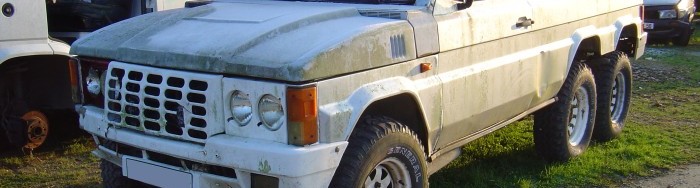
La Marque ARO (Automobiles ROumaines) naît après la seconde guerre mondiale. En 1957 , une version d’un tout terrain léger cherchant a ressembler a la Jeep américaine voit le jour.
(CF photo tiré de 4rouesmotrices.com , photo de Régis Laborde)
En surfant sur le net , je découvre par hasard un Aro version 6 roues…. Bien décidée à en savoir un peu plus , je contacte Werner sur le site Aro qui m’a répondu gentiment …
Voici sa réponse (traduite de l’allemand par moi même)..
L’ARO version 6 roues fut construit par la Marque ARO elle même , il s’agit d’une version 6×4 dépanneuse. Une série de 15 fut crée pour le réseau DACIA , avant que DACIA ne soit reprit par le groupe Renault . En version plateau ou avec Grue de chargement, 10 exemplaires furent construits sur commande uniquement .Le moteur est un turbo diesel polonais , 2417 cc et 87 ch. C’est ARO qui produit par contre la boite de transmission 5 vitesses.(CF photo dépanneuse.)
Werner a lui aussi cherché sur le net , et il a découvert une autre version de ARO 6 roues. Il pense que cette version a été produite en France par contre .. Source
De mon coté j’ai essayé de contacter les personnes de forum auto qui avaient commenté… Mais à ce jour pas de réponse
Donc si quelqu’un les connait (ou reconnait), ou bien si quelqu’un a des informations sur cet ARO 6 roues, qu’il nous contacte via le site… Nous partagerons avec votre accord vos informations ….


 Le show à l’américaine !


 Sympa la version en Lego